
The Odyssey (2026)
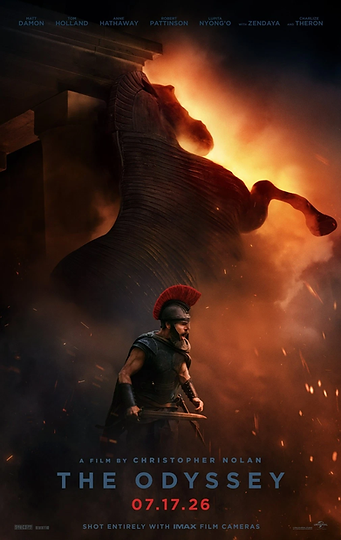
Okay here it is. The big one. The biggest director in the world adapting the epic to end all epics. Shot entirely in IMAX 70mm magnificence, starring possibly the finest actor of his generation, and filmed in locations all over the world. This is big. As big as big can get. And it's finally here.
Homer's original story, widely considered one of the most (if not the most) seminal works in the history of mankind, focuses on the time after the Trojan War. The Greeks have won thanks in no small part to the lead of this story, Odysseus, and now it's time to head home which, for all involved, is easier said than done. What follows is classic Christopher Nolan, time-jumping between multiple narratives and ratcheting up the pace to breakneck levels in the process. It is a style first deployed in 'Dunkirk' (2017) and he hasn't looked back since. It is a quite dizzying method of filmmaking that makes little concession for the casual viewer. You need to pay attention to every frame or you might find yourself as lost as Odysseus and his crew after a short time on the road.
To try and surmise succinctly, there is the Ithaca narrative - a kingdom without a king, who is presumed long dead and whose house has been decimated by suitors for his long-suffering wife (played by Anne Hathaway) and thus the throne itself. The only thing that stands between these men and the highest position in the land is Penelope's reluctance to accept her husband's fate, and the King's son (Tom Holland) who is the rightful heir to the throne.
Then there is Odysseus himself - not dead at all in actual fact but shacked up on an island with the goddess Calypso who seems intent on plying him with Lotus Flower and shagging his brains out until the end of time.
Then there is the post-trojan war sequence wherein Odysseus is trying to get his men back home safely and having to navigate one-eyed giants, witches and the general feeling of being cursed by the gods.
THEN there is the trojan war itself, wherein the Greeks offer up the gift of the big horse as a symbol of defeat and...well, you know how that goes.
If your head hurts at the prospect of all this, fear not. Because you don't come to an IMAX 70mm Christopher Nolan film to be wowed by the 'plot', you come for the spectacle and, in that regard, the film does not disappoint in the slightest. Indeed such was the sheer vastness of it all that you find your mind immediately asking 'would this hold up on my phone while I'm sitting on the toilet in an airport?'. Results to follow. However in the format in which Nolan intended you to see it, the immersive nature of the format absolutely takes hold, pulls you in, and doesn't let go for the entire three-hour running time.
Matt Damon plays the titular role and proves once again that he is a man who can do just about anything in front of a camera. He is at once strong, decisive, heroic, knackered, morally ambiguous, and haunted by the actions of his past. Part of this is down to the script, which takes the classic 'Trojan Horse' tale and does something that many other tellings of this story tend to ignore. Damon's Odysseus is a man who feels that his actions set the course for all of humanity to lose their moral compass. By violating the trust of the people of Troy, has he in fact made it ok for all who follow to ignore virtue in favour of personal gain? One could argue that this is a debate that continues today.
The stellar ensemble cast also play their part - Tom Holland shining in his father's footsteps, Robert Pattinson being an absolute snide, Charlize Theron being suitably alluring, Anne Hathaway being suitably harassed - but it is Damon's film. He is the emotional centre which we find ourselves orbiting around. Without that, all of the visual mastery and noise and plunder doesn't work. In fact, this may be Nolan's most human film so far solely because of this central performance. Yes he is fighting the undead, and giants, and sea monsters, but ultimately he's just a man trying to get home to his wife and kid, and that is what makes this film, and this performance in particular, so appealing.
That said, I will admit that upon first viewing multiple things bothered me. I mean really bothered me. And rather than go on a long-winded diatribe about an opinion which is now no longer existent, here are some initial notes taken during the first go around:
'Tom Holland sounds like a newsboy from 1920s Brooklyn'
'American accents....why?'
'Hathaway. Dreadful.'
'Contemporary dialogue.....WHY?!'
'Samantha Morton is almost as hammy as her pigs'
'Josh Safdie as Agamemnon. Screech Powers in a helmet.'
'Elliot Page'
Thus I left the first screening feeling, shall we say, underwhelmed. However, upon second viewing none of this registered at all and the entire thing rollicked past in three hours of pure bedazzlement, proving that by simply giving yourself over to the someone as brilliant as Christopher Nolan, you'll be taken exactly where you want to go. Who knows, maybe a third viewing will be even more rewarding still. Or Tom Holland's accent could clang in the ears like a gong being hit with a lead pipe. Again, results to follow.
Visually it is up there with the very best of them and there are multiple set-pieces which leave you in awe, but it's the moral quandary that resonates most and offers a deeper dimension than you might expect from a film where a cyclops gets shanked in the eye. Yet again we find ourselves in the presence of greatness, with Christopher Nolan really being in a class of his own in terms of making big cinematic spectacles that are not only awe-inspiring, but thought-provoking and offer further evidence that a night out at the movies really can continue to be one of the best things you can do with your time. A few unanswered long-term questions remain, but for now it's very much worth getting yourself a big bag of popcorn, a comfy seat, and the largest screen you can find to enjoy this epic.
★★★★☆
JB.


Comments